Getting API access
How to obtain programmatic API access to logcat.ai, the open-source developer program for OSS maintainers and the api_access capability for …
Integrate logcat.ai into your own tools and pipelines, authentication and API keys, the REST quickstart, lifecycle polling, WebSocket streaming, webhooks, and the MCP server.
Build against logcat.ai over HTTP, stream results over WebSocket, and receive signed webhooks. This section is the contract for all three.
The public API is /api/v1/*. To get a key: open-source maintainers apply through the developer program, and enterprise accounts enable the api_access capability. See Getting API access for which path applies to you.
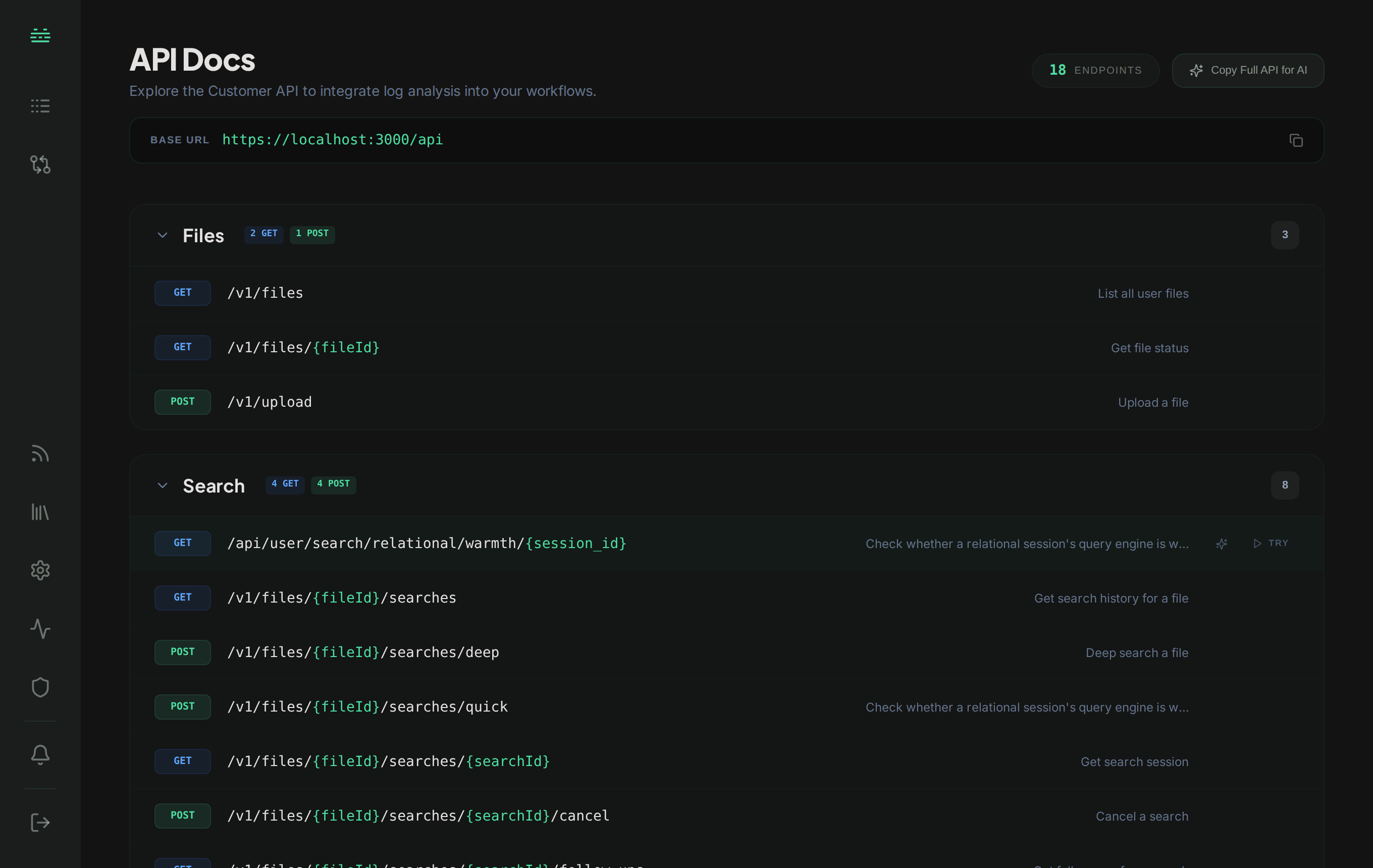
New to the API? Start with the quickstart, then Authentication & API keys. Requests use an Authorization: API_KEY <key> header, not Bearer. The full endpoint contract is in the REST API reference.
How to obtain programmatic API access to logcat.ai, the open-source developer program for OSS maintainers and the api_access capability for …
Make your first logcat.ai API call with curl, upload a log file, poll for completion, fetch the dashboard, and run a search over the /api/v1 …
How to authenticate to the logcat.ai API, the Authorization API_KEY header (not Bearer), and generating and rotating keys.
The logcat.ai analysis status values, how to poll them, and how to handle a failure.
The logcat.ai WebSocket protocol for streamed search and Delta comparison, connect URLs, the request frame, and the seven streamed message …
Register a logcat.ai webhook to receive activity events as signed JSON POSTs, the payload shape, the X-Logcat-Signature HMAC, idempotency, …
The logcat.ai API conventions, the {code, message, data} response envelope, the error model, pagination, and rate limits shared across every …